

In any successful enterprise, the finance department transcends mere transactional accounting, serving as a pivotal strategic partner. It’s the core of financial health, ensuring compliance, and provides the strategic insights that drive growth and stability. At Organimi, we understand that a clear organizational structure is the blueprint for success in any department, especially one as critical as finance. Let’s explore how a well-structured finance department operates.
What Is a Finance Department Organizational Structure?
The organizational structure of a finance department acts as its foundational framework, detailing how responsibilities are allocated, activities are coordinated, and supervision is managed. It further serves as a visual guide to the department’s hierarchy, ensuring all roles and reporting lines are transparent. Establishing such a clear structure is key to meeting business objectives, maintaining regulatory adherence, and providing high-quality financial support.
The Main Components of a Finance Department Organizational Structure
A finance department’s organizational structure divides responsibilities across several key roles, with each playing a unique part in the functioning of the department. This structure is designed to provide comprehensive financial management, from day-to-day transactions to strategic planning, while optimizing for the typical resource constraints of a small to medium-sized enterprise:
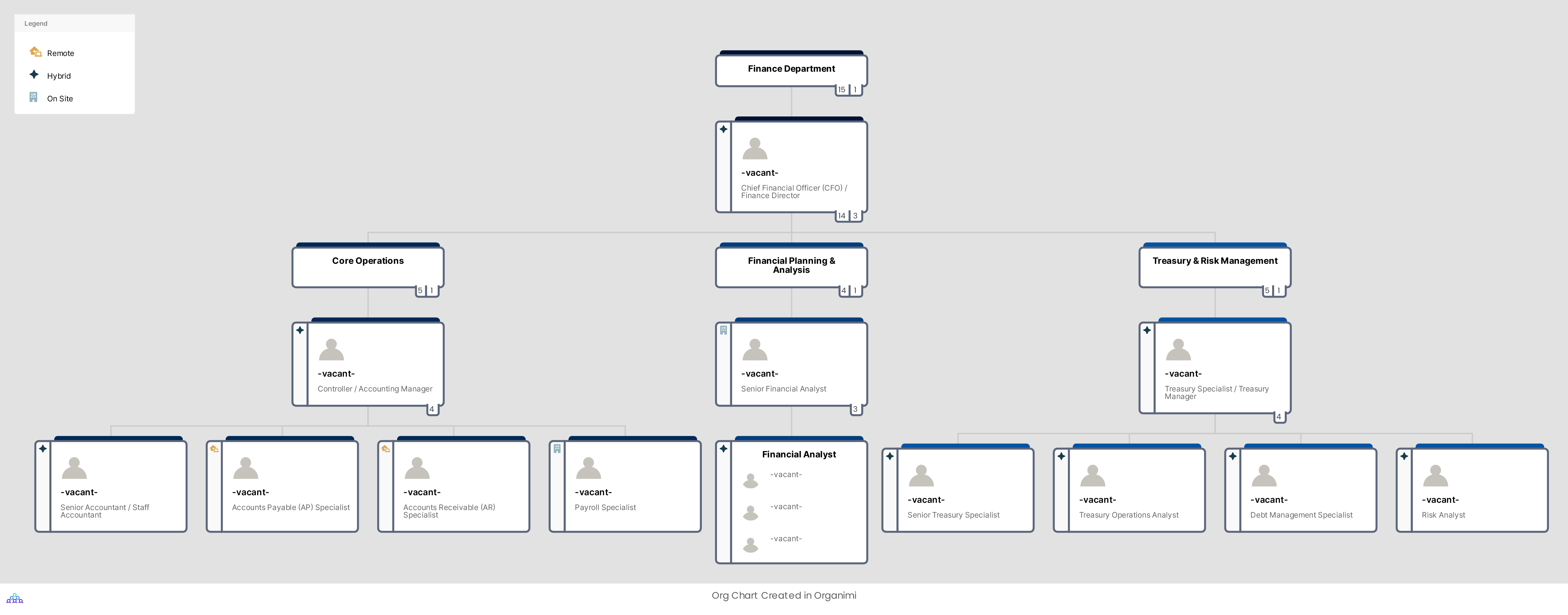
Chief Financial Officer (CFO) / Finance Director — The head of the department, responsible for overall financial strategy, planning, risk management, and reporting to executive leadership. They oversee all financial operations and drive financial performance.
Finance Manager / Controller — Reports directly to the CFO/Finance Director. They oversee the day-to-day operations of the accounting team, ensure accurate financial reporting, manage internal controls, and often handle budgeting and forecasting.
Accountants — Perform general ledger activities, prepare financial statements, manage reconciliations, and assist with audits.
Accounts Payable Specialist(s) — Process invoices, manage vendor payments, and handle expense reports.
Accounts Receivable Specialist(s) — Manage customer invoicing, track collections, and reconcile customer accounts.
Payroll Specialist(s) — Manages employee payroll, ensures compliance with tax regulations, and handles benefits deductions. In smaller departments, this might be a duty of an Accountant or HR.
Financial Analyst(s) — Conduct financial modeling, analysis, budgeting, and forecasting. They provide insights to support strategic business decisions
Treasury Specialist(s) — Manages cash flow, banking relationships, investments, and debt. More common in larger organizations, this function ensures liquidity and optimizes financial assets.
Compliance Officer / Internal Auditor — Ensures adherence to financial regulations, internal policies, and risk management frameworks. This role can be dedicated or integrated into the responsibilities of the Finance Manager or CFO in smaller setups.
The Different Types of Finance Department Organizational Structures
Just as various businesses adopt distinct organizational structures to suit their operations and customer service goals, finance departments can also use different models.
Traditional Structure — This structure has a clear chain of command, with decision-making coming from the CFO/Finance Director at the top and flowing down to the staff. It’s usually used by companies where strict control and formal reporting lines simplify complex financial operations.
Functional Structure — This structure divides the finance department into specialized teams based on roles, such as accounting, financial planning & analysis (FP&A), and treasury. Each team is led by a manager who reports to the Finance Manager or CFO. This is ideal for departments needing specialized expertise to focus on distinct areas of financial operations.
Divisional Structure — The divisional structure organizes the finance department into divisions that could be based on business units, product lines, or geographic regions. Each division is supervised by a division manager (e.g., Finance Manager for Division A) and functions with a level of autonomy. Large, diversified companies sometimes use this structure to allow for tailored financial strategies for different segments or markets.
Steps on How to Create Your Finance Department Organizational Structure
Follow this step-by-step guide on how to create a well-defined organizational structure for your finance department:
List Down Key Roles and Functions — Start by determining the essential roles and functions needed for your finance department to operate smoothly. These usually include accounting, financial reporting, budgeting, treasury, and compliance. Next, identify all the key roles within these departments by clearly defining each of their responsibilities. This step helps make sure all critical aspects of your finance department are efficiently managed to meet your company’s financial goals.
Delineate the Reporting Relationships — Starting from the top, decide who holds decision-making authority. From the CFO/Finance Director going down, outline the reporting lines. This helps reduce confusion and promote accountability, which helps teams or departments collaborate more efficiently.
Pick the Right Organizational Structure — Your structure will serve as the foundation for how your finance department will achieve its operational objectives. Consider your company’s size, operational needs, and goals so that you can select the most suitable organizational structure.
Create Your Organizational Chart — To effectively map out your finance department’s structure, use an intuitive org chart tool like Organimi, ensuring all positions and their reporting lines are clearly articulated for improved understanding across the team.
Implement and Share Your Organizational Chart — With your org chart finalized, it’s time to communicate it to all your staff and relevant stakeholders. Encourage questions and feedback to ensure the org chart remains clear and cohesive. Regularly update your chart to reflect any operational changes or shifts in your finance department.
In Summary
A well-planned organizational structure is beneficial to a finance department’s goals as it helps ensure efficient operations and effective service delivery. Organimi is a powerful organizational chart-maker tool that streamlines the creation of professional, informative organizational charts with extensive customization options.
Looking to build dynamic and shareable org charts? Explore what Organimi’s org chart software can do and sign up for a free 14-day trial today!