
A railway system is a massive, moving network of infrastructure, logistics, and personnel. For a railway company to run safely and on time, it needs to operate with precision. For this efficiency and successful operations, having a clearly defined organizational chart is key.
Aside from keeping the trains running smoothly, a clear structure helps improve communication across various departments, ensures adherence to critical safety regulations, and promotes accountability for key operational areas.
What Is a Railway Organizational Structure?
A railway organizational structure is the framework that dictates how tasks, responsibilities, and decision-making authority are coordinated within the railway company. It provides a visual representation of the organization’s hierarchy, showing all roles and reporting relationships.
Having a well-defined org chart ensures everyone knows their specific job and who they report to. This clarity is essential for a complex, safety-critical industry like rail.
The Main Components of a Railway Organizational Structure
The roles within a railway company can be broadly categorized, each playing a vital part in the entire system’s functionality.
Executive Leadership (Board/CEO) — This group oversees the entire organization, setting the strategic direction, financial policy, and ensuring overall governance and long-term success.
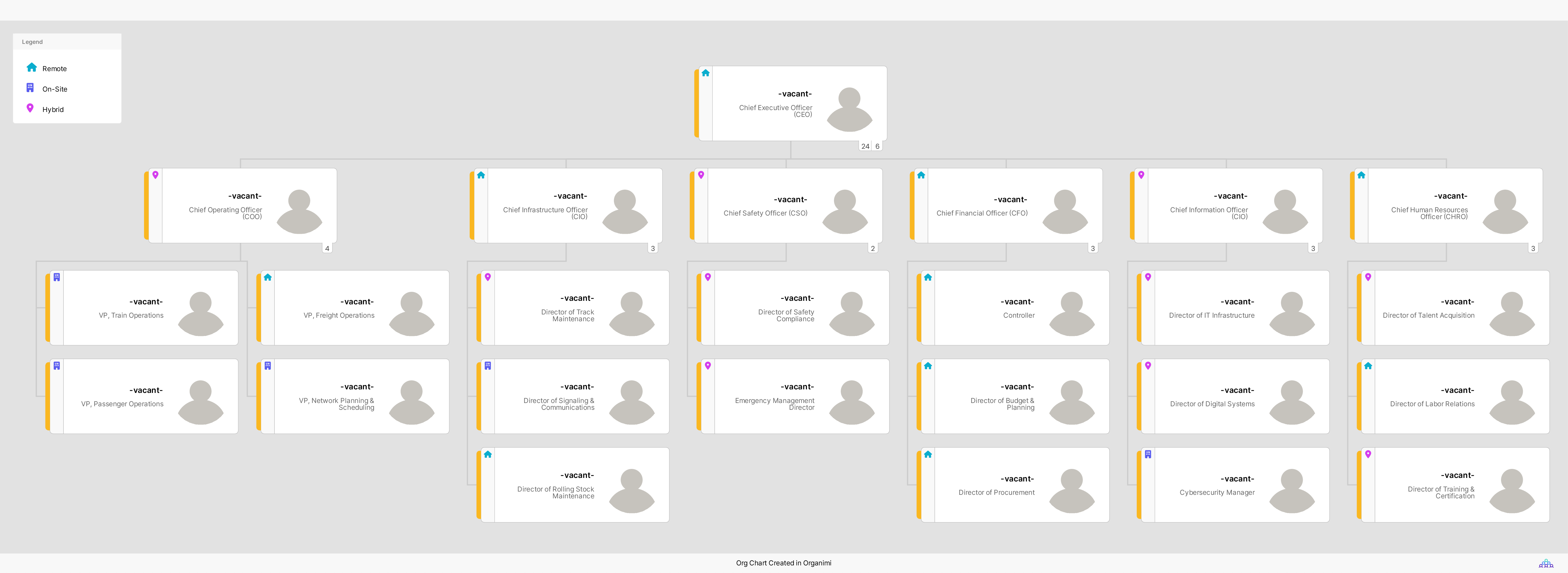
VP of Train Operations (Chief Operating Officer) — This VP is responsible for the day-to-day running of the railway, including train scheduling, dispatching, and managing station and yard staff. They ensure all services are delivered safely, on time, and efficiently.
Director of Signaling & Communications — This leadership role is dedicated to the technical systems that enable safe train movement. They manage the maintenance and development of all signals, interlocking systems, and communication networks that control the railway.
Director of Mechanical & Rolling Stock — This unit handles the locomotives and carriages (rolling stock). Their responsibilities include overseeing all heavy maintenance, repair, and ensuring the fleet is operational, safe, and modernized.
The Different Types of Railway Organizational Structures
Railways often adopt organizational structures that best suit their size, market focus, and geographic reach.
Hierarchical (or Traditional) Structure — This is the most common model, featuring a clear, top-down chain of command. Decision-making flows from the executive level down to functional staff. This works well for maintaining strict control and formal reporting lines, which is often preferred for managing complex and safety-intensive operations.
Functional Structure — The organization is divided into departments based on specialized roles, such as Engineering, Operations, and Finance. This structure is ideal for organizations that benefit from a high degree of specialization in distinct areas.
Divisional Structure — The railway is organized into semi-autonomous divisions based on geographic zones, specific rail lines, or key business markets, for example Freight Divisions versus Passenger Divisions. This allows each division to tailor its strategy to its specific market needs and act as a profit center.
Matrix Structure — Often used by large national railway systems, this combines functional and divisional structures. Staff may report to both a Functional Head (e.g., Chief Engineer) and a Geographic/Divisional Manager (e.g., Zonal Manager). This balances centralized expertise with local operational focus.
Steps to Create Your Railway Organizational Chart
A clear organizational chart is a living document that should evolve with your business. Here’s how to build one that truly works:
List Down Key Roles and Functions — Start by identifying the core functions your railway needs to perform to achieve its goals, like train running, infrastructure maintenance, rolling stock management, safety and security, and commercial services. Then, define all the key roles and their specific responsibilities within those functions. This ensures every critical aspect is managed efficiently.
Pick The Right Organizational Structure — Consider your railway’s size, complexity, operational needs, and market focus. Do you need the strict control of a Hierarchical structure, the specialization of a Functional one, or the market responsiveness of a Divisional model? The chosen structure will serve as the foundation for how you achieve your operational objectives.
Delineate the Reporting Relationships — Starting at the top with the leadership, clearly outline who reports to whom. These reporting lines establish the chain of command, which is crucial in a railway environment where rapid and accountable decision-making is essential for safety and incident response. This step helps to reduce confusion and promote team accountability.
Create and Share Your Organizational Chart —Use a user-friendly tool such as Organimi to visualize your structure. Make sure to include all roles, names, and reporting relationships to help everyone understand their place in the organization. Communicate the finalized chart to all staff and stakeholders. Regularly update your chart to reflect any organizational changes, new projects, or shifts in personnel to maintain accuracy.
In Summary
A railway is a complex system of interconnected parts, and its success hinges on efficient operations and effective service delivery. A well-planned and clearly communicated organizational structure is a key component in achieving this goal.
Looking to build dynamic and shareable org charts? Explore what Organimi’s org chart software can do and sign up for a free 14-day trial today!