
The United States Department of Justice plays a critical role in upholding the law, defending the interests of the government, and ensuring public safety. As one of the most prominent federal agencies, the Department of Justice must operate with precision, accountability, and transparency to maintain public trust and deliver justice efficiently.
A key component in making that happen is a well-organized and clearly defined organizational structure. This framework helps streamline internal operations, supports better decision-making, enhances inter-agency collaboration, and ensures every office, team, and role works toward a unified mission.
What Is the Department of Justice’s Organizational Structure?
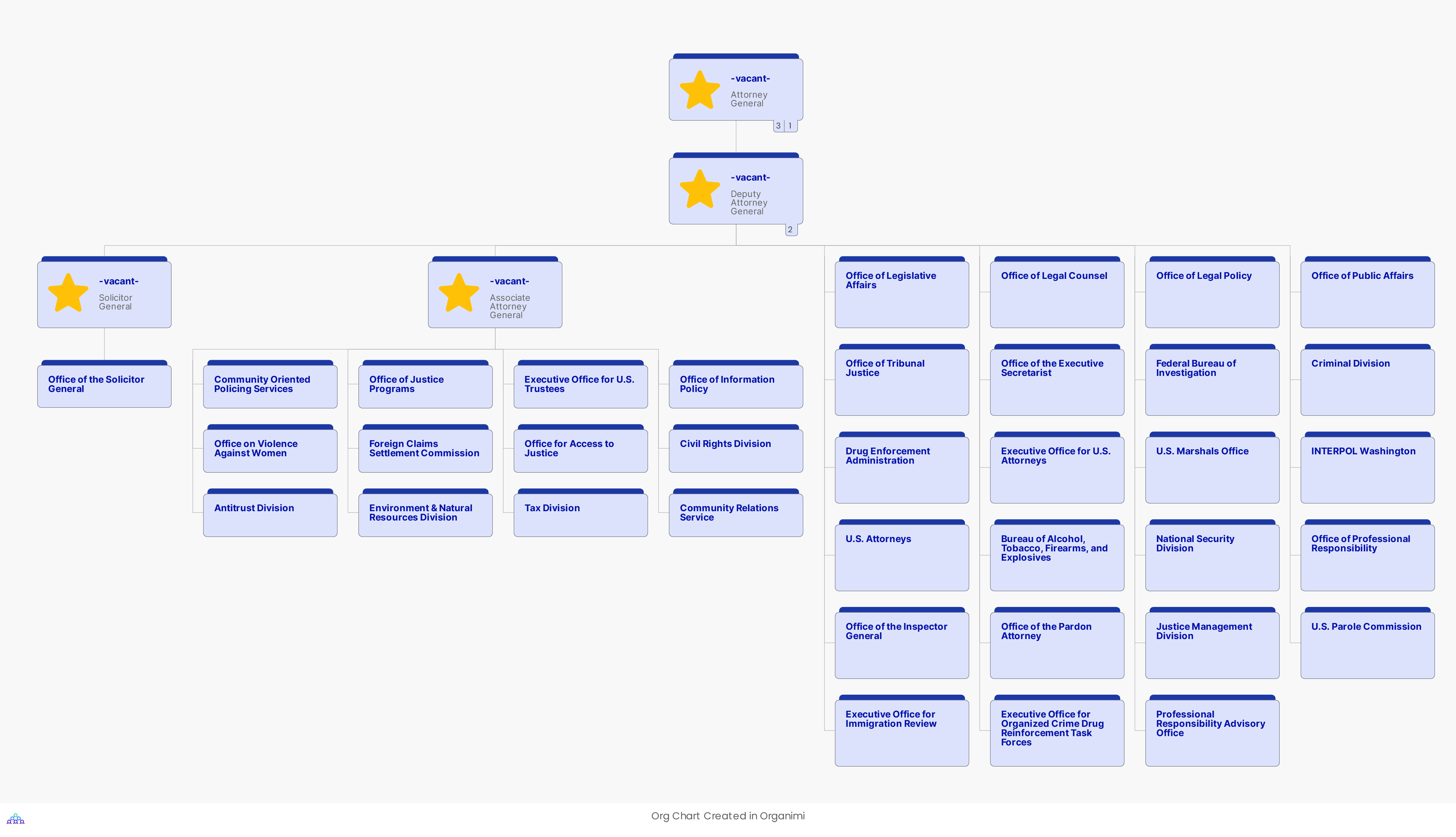
The Department of Justice’s organizational structure outlines how the Department is arranged, including its hierarchy, divisions, and reporting relationships. It serves as both a practical and visual guide to who does what and who reports to whom, ensuring responsibilities are clearly communicated and efficiently executed.
Having this structure in place allows the Department of Justice to meet its legal and operational objectives while maintaining alignment with federal oversight and accountability standards.
The Core Components of the Department of Justice Organizational Structure
The Department of Justice is composed of several major offices, leadership positions, and specialized law enforcement agencies, each playing a unique role in enforcing the law and protecting civil rights.
Attorney General — The Attorney General is the head of the Department of Justice and serves as the chief law enforcement officer of the federal government. This role involves making top-level policy decisions and overseeing the entire department.
Deputy Attorney General — The Deputy Attorney General manages the Department of Justice’s day-to-day operations and acts as the principal advisor and delegate of the Attorney General.
Associate Attorney General — The Associate Attorney General oversees the department’s civil justice, public safety, and law enforcement matters.
Criminal Division — Prosecutes federal crimes and develops criminal justice policy.
Civil Rights Division — Enforces federal statutes prohibiting discrimination.
Civil Division — Represents the U.S. in legal matters like immigration, tort claims, and consumer protection.
Antitrust Division — Ensures fair competition and investigates monopolistic behavior.
Environment and Natural Resources Division — Manages cases related to environmental laws.
Tax Division — Handles civil and criminal tax matters.
FBI (Federal Bureau of Investigation) — Investigates domestic threats and enforces federal laws.
DEA (Drug Enforcement Administration) — Focuses on drug-related crimes and enforcement.
ATF (Bureau of Alcohol, Tobacco, Firearms and Explosives) — Investigates offenses involving firearms and explosives.
U.S. Marshals Service — Provides security to federal courts and apprehends fugitives.
INTERPOL Washington — Coordinates international law enforcement with the U.S.
Office of Legal Counsel — Advises the President and agencies on legal matters.
Justice Management Division — Handles internal administration like finance, HR, and IT.
Office of the Inspector General — Investigates misconduct and audits the Department of Justice’s programs.
Office of Professional Responsibility — Ensures the Department of Justice’s lawyers meet ethical standards.
Types of Department of Justice Organizational Models
While the Department of Justice itself operates under a traditional hierarchical structure, similar public sector organizations may adopt different models depending on their mission:
Traditional Hierarchy — Clear lines of authority and reporting, ideal for law enforcement and government agencies.
Functional Structure — Divides departments by specialty (e.g., civil, criminal, policy), enabling deep expertise in key areas.
Matrix Structure — Less common in the federal government but used for cross-departmental initiatives and collaboration.
Steps on How to Build Your Own Organizational Structure
Whether you’re in the public or private sector, a clear organizational structure is essential. Here’s how to get started:
Identify Your Mission and Key Functions — Begin by defining your agency’s mission, like enforcing laws, protecting rights, or managing public programs. Then break this mission down into core functions, such as legal services, law enforcement, administration, and oversight. These functions form the backbone of your structure.
Define Roles and Responsibilities— For each function, outline the key roles and what they’re responsible for. In the Department of Justice, for example, this includes roles like Attorney General, Deputy Attorney General, and heads of divisions like Criminal, Civil, and Civil Rights. Clear role definitions prevent overlap and ensure accountability at every level.
Establish Reporting Relationships — Government agencies rely on a strong chain of command. Lay out who reports to whom, starting from top leadership (like a Cabinet-level Secretary or Director) down to department heads and support staff. This supports transparency, coordination, and compliance.
Choose a Suitable Structure — Public-sector organizations like the Department of Justice typically use a hierarchical structure, ideal for maintaining order, oversight, and clear decision-making. If your agency spans multiple regions or services, consider a divisional model to give different branches autonomy while keeping overall leadership centralized.
Visualize with an Org Chart — Turn your structure into a visual format using Organimi. This allows you to clearly map reporting lines, display leadership and departmental roles, and share updated versions across your agency.
Communicate and Keep It Updated — Once your org chart is built, share it with your teams. Make sure everyone understands the structure, their place in it, and how it supports your mission. Update regularly to reflect new leadership, programs, or structural changes.
In Summary
The U.S. Department of Justice is a complex but highly organized federal agency tasked with one of the most important missions in the nation: upholding the rule of law. With a clearly defined organizational structure, the Department of Justice ensures coordination across its many offices and agencies to deliver justice fairly and efficiently.
Looking to build dynamic and shareable org charts? Explore what Organimi’s org chart software can do and sign up for a free 14-day trial today!