

Effective procurement is about much more than purchasing. It requires careful planning, supplier relationships, contract management, and financial oversight, all working together through a team that knows exactly who is responsible for what.
Procurement departments bring together strategic planners, category managers, contract specialists, and operations staff who need to function as a coordinated unit. When roles are unclear, procurement decisions slow down, supplier relationships suffer, and costs creep up in ways that are difficult to trace back to a root cause.
A well-defined procurement organizational structure gives everyone on the team clarity about how decisions get made, who owns which relationships, and how the department connects to the wider business. An org chart makes that structure visible and easy to communicate across the organization.
What Is a Procurement Department Organizational Structure?
A procurement org structure is a visual representation of how leadership, teams, and individual roles are arranged within a procurement function. It defines reporting relationships, outlines areas of responsibility, and shows how different specializations work together to source goods and services, manage suppliers, and control spend.
A clear structure helps procurement teams operate more efficiently, supports better collaboration with internal stakeholders, and makes it significantly easier to onboard new team members and scale the function as the organization grows.
The Main Components of a Procurement Department Organizational Structure
While every procurement function varies in size and scope depending on the industry and organization, most rely on a core set of roles to operate effectively.
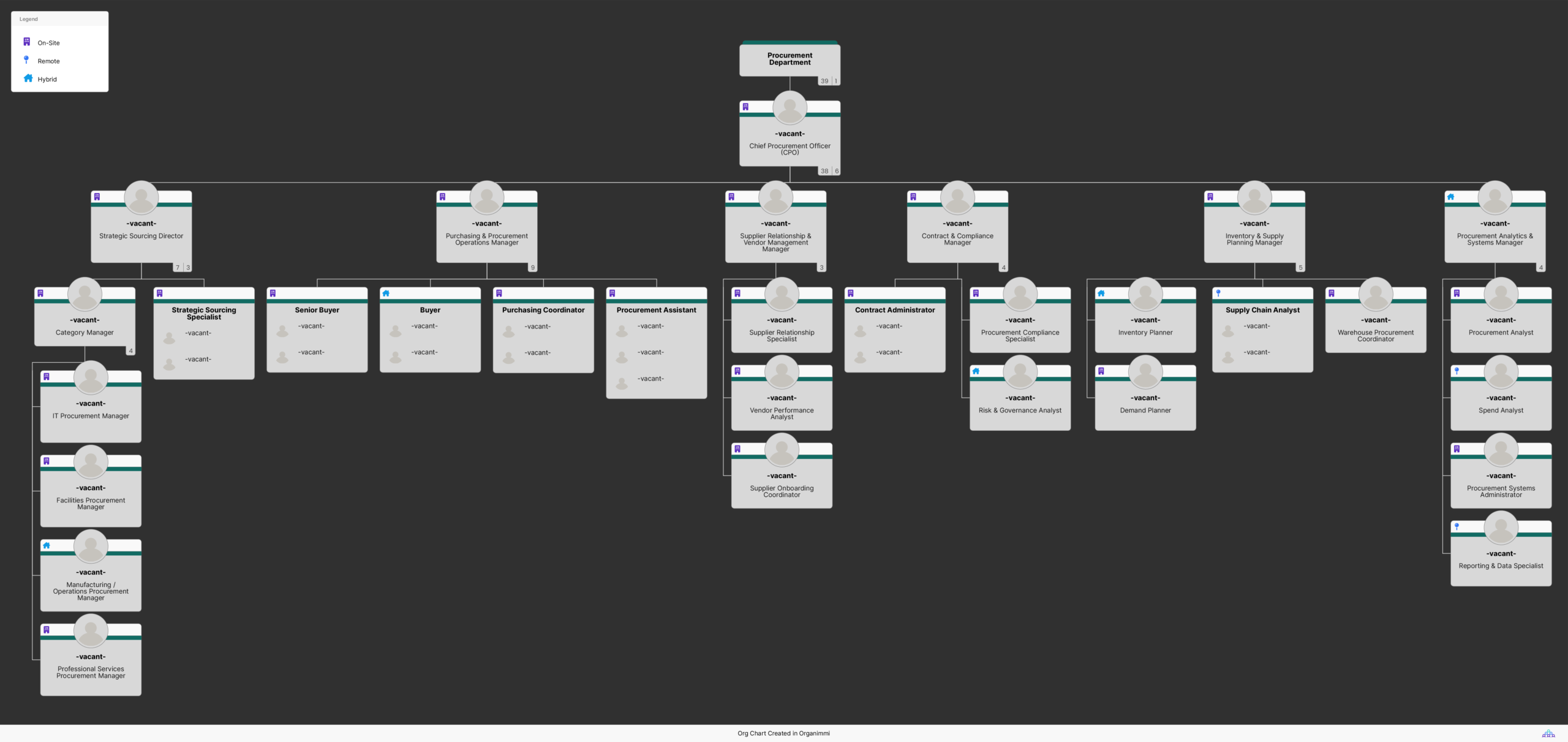
Chief Procurement Officer or Head of Procurement — The CPO or Head of Procurement leads the entire function. This role sets the procurement strategy, oversees supplier relationship management at the senior level, manages the procurement budget, and ensures the department delivers measurable value to the business.
Category Managers — Category managers are responsible for specific areas of spend, such as IT, facilities, marketing, or raw materials. They develop sourcing strategies for their category, manage supplier relationships, lead negotiations, and monitor market trends that could affect cost or supply.
Procurement Analysts — Procurement analysts support strategic decision making by collecting and analyzing spend data, evaluating supplier performance, tracking savings, and producing reports for leadership. They provide the data foundation that helps category managers and senior leadership make informed sourcing decisions.
Sourcing Specialists — Sourcing specialists manage the tactical execution of procurement activities. This includes running RFPs and RFQs, evaluating supplier proposals, coordinating bid processes, and supporting contract negotiations. They work closely with category managers to ensure sourcing activity is aligned with the broader strategy.
Contracts and Compliance Manager — This role owns the contract lifecycle from drafting and review through to renewal or termination. They ensure that supplier agreements meet legal and regulatory requirements, track contract obligations and milestones, and work closely with legal teams to manage risk.
Supplier Relationship Manager — In larger procurement functions, a dedicated supplier relationship manager focuses specifically on managing strategic supplier partnerships. They also work to develop long-term partnerships that deliver value beyond the initial contract.
Procurement Operations and Administration — These roles support the day-to-day running of the procurement function. Responsibilities include purchase order processing, invoice management, system administration for procurement platforms, and maintaining supplier databases.
Common Procurement Department Organizational Structures
Procurement teams typically adopt one of a few common structures depending on the size of the organization and the complexity of its supply chain.
Hierarchical Structure — All procurement activity is managed through a single central team. This model provides strong spend visibility, consistent processes, and significant negotiating leverage through consolidated purchasing. It works well for mid-sized organizations looking to maximize efficiency and control.
Functional Structure — Procurement responsibility is distributed across individual business units or departments, each managing their own sourcing and supplier relationships. This approach gives business units more autonomy and can be faster for tactical purchasing.
Center-Led Structure — A hybrid model where a central procurement team sets strategy, standards, and policies while individual business units retain some autonomy in their day-to-day purchasing decisions. This is one of the most common models in larger organizations because it balances control with flexibility.
Category-Based Structure — The procurement team is organized around specific spend categories rather than business units. Each category manager owns end-to-end procurement for their area, from strategy through supplier management. This model supports deep category expertise and is particularly effective in organizations with complex, high-value spend categories.
How to Create a Procurement Organizational Chart
Identify Core Roles and Teams — Start by mapping out the key roles within your procurement function. Include both strategic roles like category management and sourcing, and operational roles like contracts administration and purchase order processing. Clarity at this stage makes the final chart easier to read and more useful across the organization.
Define Responsibilities — Document what each role owns, including decision-making authority, supplier relationship ownership, and cross-functional responsibilities. Clear definitions reduce duplication of effort and help new team members understand where they fit from day one.
Map Reporting Relationships — Establish who reports to whom across the function. This creates accountability and ensures that both strategic and operational workstreams have clear ownership and escalation paths.
Build and Maintain the Chart — Use an organizational chart tool like Organimi to create a chart that is easy to update as your team evolves. Organimi makes it simple to add new roles, adjust reporting lines, and share an accurate view of the procurement structure with stakeholders across the business.
In Summary
Procurement departments perform best when roles are clearly defined, reporting lines are transparent, and the structure reflects how the team actually operates. A well-maintained org chart is one of the most practical ways to make that clarity visible and accessible to everyone involved.
With a clean, up-to-date organizational chart, procurement teams can improve cross-functional collaboration, support faster decision making, and build a structure that scales as spend complexity and team size grow.
Looking to build dynamic and shareable org charts? Explore what Organimi’s org chart software can do and sign up for a free 14-day trial today!