

Catering goes far beyond simply preparing food: it’s about orchestrating memorable experiences through culinary excellence and flawless execution. To build a thriving catering operation, businesses need tight coordination, outstanding cuisine, and service that exceeds expectations. One fundamental element that makes this possible is establishing a well-defined organizational structure.
A solid structure does more than organize workflows. It guarantees adherence to food safety protocols, strengthens collaboration among team members, and transforms the client experience. When your staff understands exactly where they fit and what’s expected of them, events become a seamless experience.
What Is a Catering Organizational Structure?
An organizational structure for catering companies defines how responsibilities are allocated, work is synchronized, and oversight is maintained throughout the business. Think of it as a blueprint that maps out your company’s hierarchy, illustrating every position and how they connect to ensure crystal-clear accountability.
Implementing a thoughtful organizational structure enables your catering business to achieve service excellence, stay compliant with health regulations, and execute events with consistency. From intimate dinner parties to large-scale galas, your structure provides the backbone that supports every service.
The Main Components of a Catering Organizational Structure
Within a catering organization, responsibilities flow through multiple essential positions, each contributing distinct expertise to deliver successful events.
Catering Director — The Catering Director commands the entire operation. This leadership role involves making strategic choices that shape the company’s trajectory, quality benchmarks, and competitive positioning in the market.
Operations Manager — The Operations Manager coordinates staff assignments, liaises with suppliers, and monitors service standards. This position answers directly to the Catering Director.
Executive Chef — At the heart of culinary excellence, the Executive Chef designs menus, establishes preparation protocols, and runs kitchen operations. This role guarantees every plate meets quality targets and accommodates special dietary needs while leading the culinary brigade.
Sous Chef — Acting as the Executive Chef’s right hand, the Sous Chef supervises kitchen personnel, monitors food prep, and takes command of kitchen operations as needed. This position maintains uniformity and excellence across every dish created.
Event Coordinators — Serving as the client’s main liaison, Event Coordinators handle scheduling details, orchestrate timelines, relay client specifications to culinary and service teams, and verify that events unfold as promised.
Service Staff/Waitstaff — These team members provide direct guest interaction at events, managing food service, tableside hospitality, and guest relations. Your service staff become the living embodiment of your brand during every event.
Kitchen Staff — Supporting the culinary leadership, Kitchen Staff handle ingredient prep, execute recipes to specification, and uphold sanitation and food safety protocols throughout the workspace.
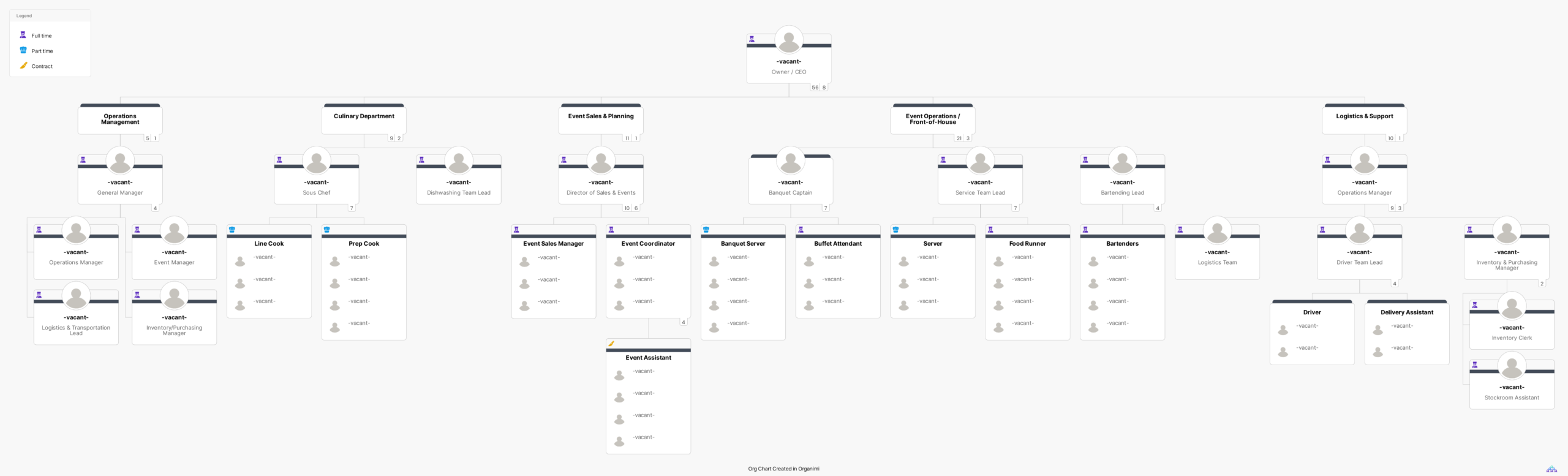
The Different Types of Catering Organizational Structures
Catering operations implement various organizational frameworks depending on their business model and service approach. Here are the most prevalent structures in the industry:
Traditional Hierarchical Structure — Built on a straightforward chain of command, authority flows from the Catering Director down through management tiers to operational staff. Larger catering enterprises often favor this model because established reporting paths and clear authority help coordinate complicated, multi-event schedules.
Functional Structure — This framework separates the business into specialized units like culinary production, event planning, and service execution. Department heads oversee their areas and report upward to the Operations Manager or Catering Director. This works particularly well for companies prioritizing specialized excellence in each operational domain.
Event-Based Structure — Teams form around individual events or event categories, with dedicated groups assigned to particular projects. Each squad brings together culinary professionals, planners, and service personnel who collaborate throughout the entire event lifecycle. This approach suits companies juggling multiple concurrent events or focusing on distinct market segments like weddings, corporate functions, or social celebrations.
Steps on How to Create Your Catering Organizational Structure
Use this practical roadmap to build a robust organizational structure for your catering enterprise:
List Down Key Roles and Functions — Begin by pinpointing the vital positions and capabilities your catering operation requires to function effectively. Typically, this encompasses culinary production, event management, service execution, logistics coordination, and back-office support. Then, catalog every key position within these domains and spell out what each role entails. This foundation ensures every crucial element of your operation has proper oversight to drive your business forward.
Delineate the Reporting Relationships — Begin at the apex and establish who wields ultimate authority. From the Catering Director or Owner downward, map out supervisory connections for every position. Clear reporting paths eliminate ambiguity and establish accountability, allowing teams to work in harmony.
Pick the Right Organizational Structure — Your chosen framework becomes the architecture upon which your catering business builds success. Evaluate factors like company size, event portfolio, expansion strategy, and service philosophy to identify the ideal structural model. Boutique caterers might flourish with straightforward traditional frameworks, whereas large-volume operators could require sophisticated divisional or hybrid configurations.
Create Your Organizational Chart — Select an org chart creation platform and build a comprehensive visual that captures your company’s structure. Document every position along with reporting connections so personnel can visualize their location within the broader organization. Remember to represent both permanent positions and typical temporary roles that expand your capacity for major events.
Implement and Share Your Organizational Chart — Once your chart is polished, distribute it across your workforce and key stakeholders. Welcome inquiries and input to confirm the chart communicates effectively and functions as intended. Refresh your chart periodically to capture operational evolution, expanded service capabilities, or business growth milestones.
In Summary
Success in catering rests on coordinated teamwork, meticulous attention to detail, and service that delights clients. A thoughtfully designed organizational structure forms the cornerstone of these achievements by driving operational efficiency, transparent communication, and experiences clients remember.
Looking to build dynamic and shareable org charts? Explore what Organimi’s org chart software can do and sign up for a free 14-day trial today!