

More than just a collection of buildings in Washington D.C., the United States Government is a complex and interconnected system that shapes the lives of millions. For citizens, businesses, and even international entities to navigate this landscape effectively, understanding its organizational structure is paramount.
Think of the US Government’s organizational structure as the foundational framework that dictates how authority is distributed, responsibilities are assigned, and power is balanced across its various branches and entities. A clear grasp of this structure isn’t just academic; it’s essential for civic engagement, regulatory compliance, and comprehending the forces that influence our society.
What Is the U.S. Government Organizational Structure?
The US Government organizational structure is a hierarchical and functional arrangement that outlines the different branches, agencies, departments, and offices that constitute the federal government. It’s a visual and conceptual representation of how power is separated among the three co-equal branches – the Executive, Legislative, and Judicial – and how various entities within each branch operate and interact. Understanding this structure is key to comprehending how laws are made, enforced, and interpreted in the United States.
The Main Components of the U.S. Government Organizational Structure
The US Government’s organizational structure is primarily defined by its three distinct branches, each with its own set of roles and responsibilities:
The Executive Branch — Headed by the President of the United States, this branch is responsible for enforcing the laws passed by Congress.
- The President — The Chief Executive, responsible for implementing laws, commanding the armed forces, appointing heads of federal agencies, and conducting foreign policy.
- The Vice President — Serves as the President’s principal assistant and assumes the presidency upon the President’s death, resignation, or removal. Also serves as the President of the Senate.
- Executive Departments — Fifteen cabinet-level departments, such as the Department of State, Department of Treasury, and Department of Defense, carry out specific governmental functions. Each is headed by a Secretary appointed by the President and confirmed by the Senate.
- Independent Agencies — Federal agencies that operate independently of the President’s direct control, such as the Environmental Protection Agency (EPA) and the National Aeronautics and Space Administration (NASA). These agencies typically have a specific mandate and are overseen by boards or commissions.
The Legislative Branch — Consisting of the Congress, this branch is responsible for making federal laws.
- The Congress — A bicameral legislature composed of two chambers:
- The Senate — Composed of 100 senators, two from each state, serving six-year terms. The Senate has unique powers, such as confirming presidential appointments and ratifying treaties.
- The House of Representatives — Composed of 435 representatives, with the number from each state based on its population, serving two-year terms. The House has the sole power to initiate revenue bills and impeach federal officials.
- Congressional Committees — Both the Senate and the House are divided into numerous committees that specialize in specific policy areas, where the bulk of legislative work takes place.
- Legislative Agencies — Agencies that support the functioning of Congress, such as the Congressional Budget Office (CBO) and the Government Accountability Office (GAO).
The Judicial Branch — Headed by the Supreme Court, this branch is responsible for interpreting the Constitution and federal laws.
- The Supreme Court — The highest court in the federal judiciary, composed of a Chief Justice and eight Associate Justices. It has the final say on legal disputes and can declare laws unconstitutional through judicial review.
- Federal Courts of Appeals — Thirteen appellate courts that hear appeals from the district courts.
- Federal District Courts — The trial courts of the federal judiciary, where most federal cases are initially heard.
- Specialized Courts — Courts with jurisdiction over specific types of cases, such as bankruptcy courts and military courts.
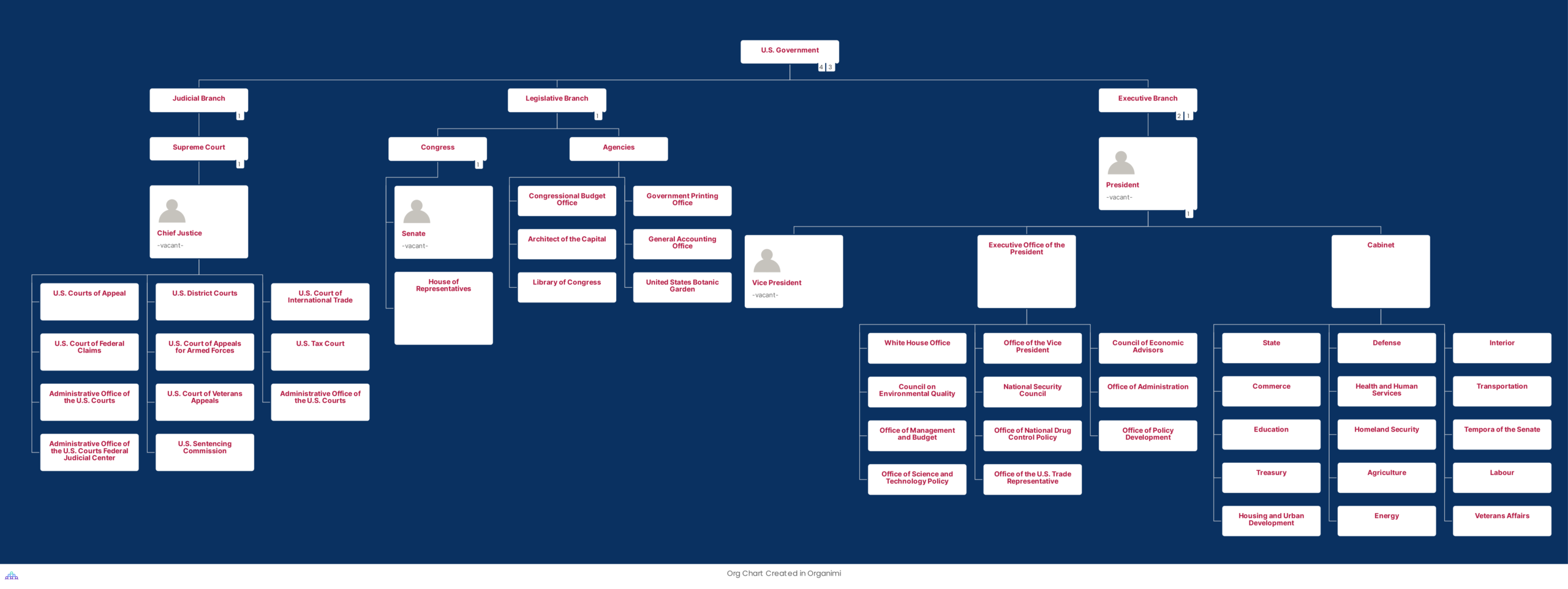
The Different Types of Government Organizational Structures
While the overarching structure is defined by the three branches, each branch also has its own internal organizational models:
Hierarchical Structure (Executive Branch) — The Executive Branch generally follows a hierarchical structure, with the President at the top, followed by the Vice President, Cabinet Secretaries, agency heads, and so on. Authority flows downwards through clear chains of command.
Committee-Based Structure (Legislative Branch) — Congress operates primarily through a complex network of committees and subcommittees. This structure allows for specialization and division of labor in the legislative process.
Hierarchical Structure with Independent Authority (Judicial Branch) — The Judicial Branch has a hierarchical structure with the Supreme Court at the top. However, individual judges and courts at lower levels exercise significant independence in their decision-making within the bounds of legal precedent and statutes.
Steps on How to Create Your Government Organizational Structure
Follow this step-by-step guide to gain a clearer understanding of the US Government’s organizational framework:
Identify the Three Core Branches — Begin by recognizing the fundamental division of power among the Executive, Legislative, and Judicial branches. Understand the primary responsibility of each branch: enforcing laws, making laws, and interpreting laws, respectively. Next, identify the key roles and entities within each branch by clearly outlining their main functions. This foundational step helps establish a basic understanding of how power is distributed at the federal level.
Delineate the Roles and Responsibilities within Each Branch — Starting with the head of each branch (President, Congress, Chief Justice), outline the key responsibilities and powers associated with each major role and entity. For example, understand the President’s power and the Supreme Court’s power of judicial review. This helps reduce confusion about who is responsible for what within the complex governmental system.
Recognize the Checks and Balances System — The genius of the US Government’s structure lies in its system of checks and balances. Understand how each branch has the power to limit the actions of the other two branches. For instance, the President can veto laws passed by Congress, Congress can impeach and remove the President or federal judges, and the judiciary can review the constitutionality of laws passed by Congress and signed by the President.
Explore the Organization Within Each Branch — Dive deeper into the internal structures of each branch. Understand the role of cabinet departments and independent agencies within the Executive Branch, the committee system within Congress, and the different levels of federal courts within the Judicial Branch. Visualizing these internal structures can be immensely helpful.
Utilize Organizational Charts and Resources — Employ resources like government websites and organizational chart tools like Organimi. These tools can provide a visual representation of the complex relationships and hierarchies within the government. Regularly refer to these resources to reinforce your understanding and stay updated on any structural changes.
In Summary
The US Government’s organizational structure with its separation of powers and intricate web of agencies and departments, is designed to ensure a balance of authority. Understanding this framework is crucial for anyone seeking to engage with or comprehend the workings of the United States.
Looking to build dynamic and shareable org charts? Explore what Organimi’s org chart software can do and sign up for a free 14-day trial today!